
Strong Room Door for Jewellery Showrooms – Grades, Thickness, Cost & Installation Guide
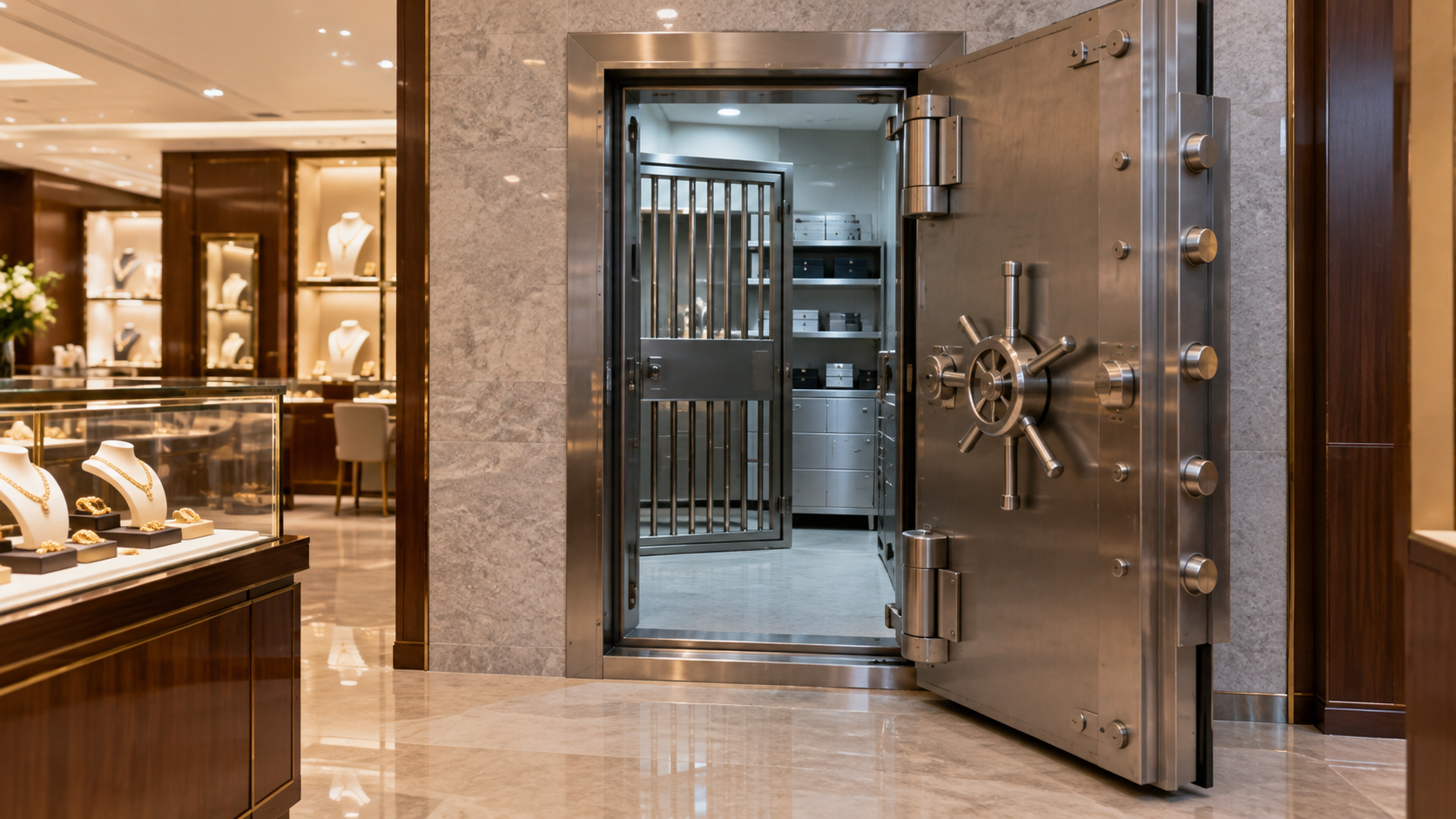
For a jeweller, the strong room is not just part of the business. In many ways, it is the business.
Consider the numbers at today's gold rate of about ₹1.5 lakh per 10 grams. Five kilograms of showroom stock is worth around ₹7.5 crore, and ten kilograms is around ₹15 crore. That stock sits behind a single door every night.
This guide explains what that door must resist, how strong room doors are graded and built, and what really drives cost. It also covers how to plan the installation so that you do not have to redo civil work later.
What a strong room door must resist
A jewellery strong room faces four kinds of threat:
- Mechanical attack: Drills, hammers, crowbars, hydraulic spreaders and angle grinders.
- Thermal attack: Gas cutting torches, oxy-acetylene sets and thermic lances.
- Fire: From the showroom itself, or spreading from neighbouring shops in crowded markets.
- Insider and forced-opening risk: Staff collusion, or criminals forcing staff to open the door.
- A good strong room design addresses all four, not just the first one.
Door grades and ratings explained
Thickness alone tells you very little. What matters is how long the door resists a skilled attack in an accredited test. These are the benchmarks to ask about:
| Standard | Applies to |
|---|---|
| Grades | What it tells you |
| EN 1143-1 | Safes, strong room doors and strong rooms |
| Grade 0 to XIII | Resistance to tool attacks, measured in laboratory "resistance units" |
| UL 608 | Vault doors and modular vault panels |
| Class M, 1, 2, 3 | Net working time against tools and torches: 15, 30, 60 and 120 minutes |
| UL 687 (TRTL) | Safes |
| e.g. TRTL-30x6 | Torch and tool resistance for 30 minutes on all six sides |
Which grade do you need? In practice, your insurer often decides. Insurers who issue a jewellers' block policy usually inspect the strong room and link the stock value to minimum protection levels. Speak to your insurer before finalising the door.
For a deeper comparison of fire-burglary and TRTL protection, read our FBR vs TRTL safe review.
Anatomy of a strong room door
A modern strong room door is a layered barrier, with each layer designed to defeat a different tool.
| Layer | Purpose |
|---|---|
| Outer steel plate | First barrier and the mounting base for the locks |
| Hardplate behind the locks | Stops drilling into the lock mechanism |
| Composite barrier (high-strength concrete with hard aggregates) | Resists grinders, drills and thermal cutting |
| Heat-dispersing layer (in torch-resistant designs) | Conducts torch heat away and slows cutting sharply |
| Inner steel plate | Final barrier |
| Bolt work and relockers | Multiple live bolts, plus relockers that jam the door if it is attacked |
Door thickness in commercial strong rooms typically falls between about 100 mm and 300 mm, depending on the grade. Two doors of the same thickness, however, can perform very differently. Always compare test ratings, not millimetres.
Here is a point that many jewellers learn too late. The door is only as strong as the walls around it. Strong room walls, roof and floor need reinforced RCC designed to match the door's grade. Your structural engineer and the door manufacturer should plan this together.
Planning a new showroom or upgrading your strong room? Involve us before the civil work starts; it saves cost and rework. Call Eshaan Enterprises on +91 91365 99447 / +91 94227 66508 or request a free consultation.
+91 91365 99447 / +91 94227 66508Essential features for a jewellery strong room
| Feature | Why jewellers need it |
|---|---|
| Dual control locks | Two people, two locks; neither can open the door alone |
| Time lock | The door cannot open outside set business hours, even with the right codes |
| Day gate (grill gate) | Keeps the strong room ventilated and visible during working hours, while staying locked |
| Emergency ventilator | Allows air and communication if someone is accidentally locked inside |
| Alarm and vibration sensors | Raise an alarm the moment drilling or cutting starts |
| CCTV coverage and access logs | Provide evidence and deterrence, and are often required by insurers |
The emergency ventilator is easy to overlook, but it is critical. Staff do get locked in by accident, and a time lock means the door cannot simply be reopened.
What drives the cost of a strong room door
There is no single "strong room door price". These factors decide the final quote:
| Cost factor | Impact |
|---|---|
| Grade or rating | The biggest driver; higher grades need thicker, more complex barriers |
| Door size (clear opening) | Larger openings need more steel and composite material |
| Lock configuration | Dual control, time locks and electronic audit locks add cost |
| Day gate, ventilator and accessories | Add-ons chosen to suit your operations |
| Frame and wall integration | Site work, anchoring and finishing |
| Transport and installation | Doors weigh several hundred kilograms to over a tonne, so handling matters |
| Indicative range: ₹[client to confirm] depending on grade and size. | Logistics deserve special attention in India's traditional jewellery markets. Narrow lanes in Chandni Chowk, Bowbazar or the old city of Hyderabad, along with ageing buildings, can affect both delivery and the structural plan. |
Installation: the right sequence
Site survey and insurer requirements: Agree the grade, size and features with your insurer and security consultant.
Strong room civil design: Plan RCC walls, roof and floor with suitable reinforcement.
Frame embedded during construction: The door frame should be cast in with the RCC. Retrofitting later is harder and more expensive.
Door delivery and hanging: The door is precisely aligned so that the bolts engage smoothly.
Lock setup and integration: Locks and time-lock schedules are programmed, and alarms are connected.
Handover and training: Staff are trained on opening procedures, and documents are prepared for your insurer.
Annual maintenance: Bolt work, locks and seals are serviced periodically.
The single most expensive mistake is choosing the door after the civil work is done. Plan the door first.
Serving jewellers across India
India's jewellery trade is concentrated in historic markets, and each has its own challenges. These include Zaveri Bazaar in Mumbai, Chandni Chowk and Karol Bagh in Delhi, and T. Nagar in Chennai. Bowbazar in Kolkata, Laad Bazaar in Hyderabad, Johari Bazaar in Jaipur, Manek Chowk in Ahmedabad and Sarafa in Indore are equally important.
Eshaan Enterprises has supplied jewellery safes and strong room doors to jewellers in [cities – client to confirm, e.g. Mumbai, Kolkata, Gwalior, Nashik, Indore]. Our clients include [client names – confirm permission before naming].
Your stock deserves an engineered solution, not an off-the-shelf door. Talk to our strong room specialists about grades, locks and installation for your showroom.
+91 91365 99447 / +91 94227 66508Frequently asked questions
What thickness should a jewellery strong room door be?
Commercial doors typically range from about 100 mm to 300 mm. Choose by tested grade rather than thickness, and confirm the grade your insurer requires.
What is a TRTL strong room door?
TRTL means torch and tool resistant. A TRTL-rated product has been tested to resist cutting torches and tools for a specified time, such as 30 minutes.
Can a strong room door be installed in an existing showroom?
Yes, but retrofitting needs structural assessment and wall strengthening. It is easiest and cheapest when planned during construction.
Does a strong room door need a day gate?
It is strongly recommended. A day gate keeps the strong room ventilated and visible during working hours while still locked.
Secure your showroom with a door built for your stock. Eshaan Enterprises manufactures strong room doors, jewellery safes and bank lockers in Pune for jewellers across India. Call +91 91365 99447 / +91 94227 66508 or request a free consultation today.
+91 91365 99447 / +91 94227 66508 Previous Post